
Apologize vs Apologise: Same Word, Two Spellings (and Which One to Use)
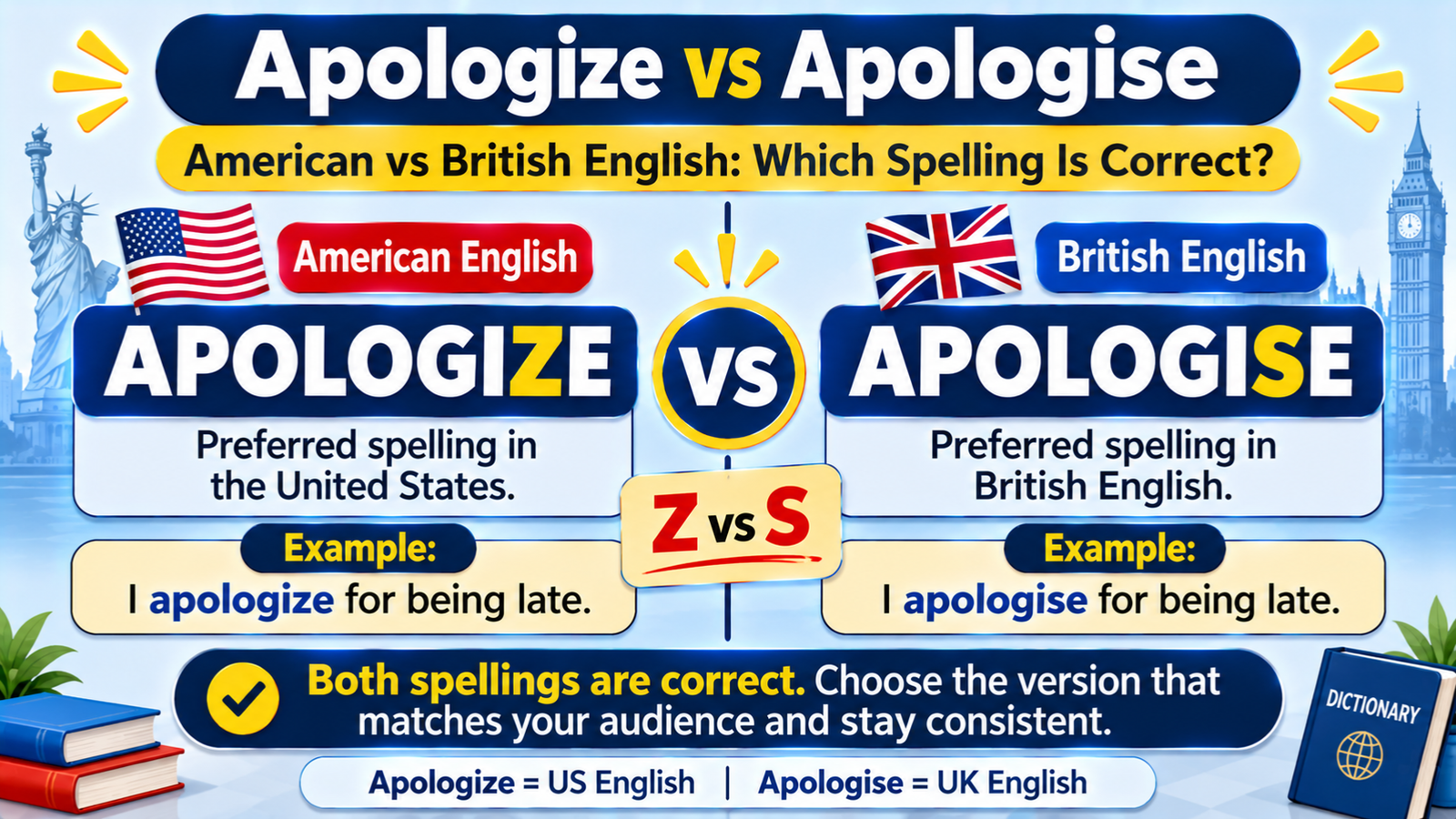
Apologize and apologise are the same word. “Apologize” is the standard American spelling and is also the usual choice in Canada. “Apologise” is common in British, Australian and Irish writing. Both mean to say you are sorry for something, and neither is a mistake, so pick the one that suits your readers and stay with it.
That is the short answer to apologize vs apologise. The rest of this guide covers real usage numbers by country, why some British publishers use the “z” anyway, the -ize/-ise rule and its exceptions, the confusing word forms (apology, apologies, apologetic), which prepositions to use, how “apologize” differs from “sorry,” and how to set your spellcheck. A short quiz is at the end.
Apologize vs Apologise: The Quick Answer
The only difference is one letter, an “s” or a “z” in the middle of the ending.
| Word | American spelling | British spelling | Example |
| Apologize | apologize, apologized, apologizing | apologise, apologised, apologising | I need to apologize/apologise for being late. |
| Realize | realize | realise | She didn’t realize/realise the shop was closed. |
| Organize | organize | organise | We will organize/organise the event next week. |
| Recognize | recognize | recognise | I almost didn’t recognize/recognise him. |
| Analyze | analyze | analyse | The team will analyze/analyse the data. |
Meaning, pronunciation and grammar stay identical. Only the spelling changes.
What Does Apologize (or Apologise) Mean?
Before the apologize vs apologise spelling debate, the meaning. To apologize is to tell someone you regret something you did or said. It is a verb, and a regular one: apologize, apologizes, apologized, apologizing (or apologise, apologises, apologised, apologising).
The word comes from the Greek apologia, which meant a spoken defense or argument. In early English, an “apology” was closer to a defense or explanation than to “I’m sorry.” Merriam-Webster records the verb’s first known use in English in 1596, and early uses could mean “to defend” or “to justify.” Over time the meaning moved to the one we use now: an expression of regret for something that caused a problem or upset someone. Because the word came from Greek, it was originally formed with the -ize ending.
Apologize Verb Forms: Every Tense in Both Spellings
The apologize vs apologise split continues through every form of the verb. Learn the pattern once and you can apply it everywhere.
- Base form: apologize (US) / apologise (UK). I apologize for the mistake.
- Third person singular: apologizes / apologises. She apologizes whenever she is wrong.
- Past tense and past participle: apologized / apologised. He apologized after the meeting.
- Present participle (-ing form): apologizing / apologising. They are apologizing to the guests.
The ending never changes the letter in the middle: if you pick the “z” version, every form keeps the “z,” and the same goes for “s.”
Which Spelling Should You Use?
For apologize vs apologise, pick based on your readers, not on which one looks nicer.
Sapling’s usage data (out of 100 examples in each country) gives a clear picture:
- United States: apologize 94, apologise 6
- Canada: apologize 91, apologise 9
- India: apologize 84, apologise 16
- United Kingdom: apologize 36, apologise 64
- Australia: apologize 36, apologise 64
- Ireland and New Zealand: apologize 43, apologise 57
So in the US and Canada, “apologize” is the clear winner. In the UK, Australia, Ireland and New Zealand, “apologise” is more common. India leans toward “apologize.”
Look at the UK number once more. Even in Britain, “apologize” shows up more than a third of the time in that data. Writing Explained points out that book-based charts show “apologize” is also very common in British English, so “apologise” may be closer to dominant in newspapers than in books. Either way, nobody in Britain will think “apologize” is an error.
Here is how I would decide:
- US or Canadian audience: apologize.
- UK, Australian, Irish or New Zealand audience: apologise, unless your publisher uses Oxford spelling (see below).
- Publisher, university or employer with a style guide: follow the guide, full stop.
- International audience with no guidance: apologize is the safer default. It is the older form, it is accepted everywhere, and most spellcheck tools accept it.
- Pakistan and India: many Pakistani and Indian schools and exam boards follow British conventions, so check your own board or teacher’s rules. Sapling’s data for India leans toward “apologize,” but I could not find a separate figure for Pakistan.
Whatever you choose, stay consistent. A document that says “apologize” in one paragraph and “apologise” in the next looks careless.
Oxford Spelling: Why British Writers Sometimes Use -ize
The apologize vs apologise question has a twist that surprises people. The “z” is not purely American. Oxford University Press and some other British publishers use -ize endings in words that come from the Greek -izein. That style is often called Oxford spelling, and it is a recognized British variety.
The reasoning is about word origin. Apologize comes from Greek, so Oxford-style writing keeps the “z”: apologize, realize, organize, recognize. But it still writes analyse, paralyse and catalyse with an “s,” because those words do not follow the same pattern.
Grammarist also notes that apologize is the original form and that apologise only recently became the preferred spelling outside North America, possibly because many people assumed “z” was purely American. So if you see “apologize” in a British book, it is usually not an American intrusion. It may well be a deliberate house style.
The -ize vs -ise Rule (and Its Exceptions)
Apologize vs apologise is just one case of a bigger pattern. The -ize/-ise split affects hundreds of English verbs, so it helps to know the rule of thumb.
In American English, nearly all of these verbs end in -ize: apologize, realize, organize, recognize, criticize, modernize.
In British English, both are acceptable (-ise is more common, -ize is the Oxford style), so the one you choose just needs to be consistent.
Some words are always spelled -ise, in both American and British English, because the “ise” is not a verb ending that can switch to “ize.” These are the common ones:
- advertise
- advise
- comprise
- compromise
- despise
- devise
- disguise
- exercise
- improvise
- revise
- supervise
- surprise
- televise
So you never write “surprize” or “advertize.” And a related pair to watch: American English writes analyze, but British English (including Oxford style) writes analyse.
A useful trick for remembering the American side: “apologiZe” has the Z of America, like the “z” in Arizona. Grammarist suggests a similar memory hook. It is not a perfect rule, but it keeps you from second-guessing the US spelling.
Apologize, Apology and Apologies: Word Forms

People often mix up the verb and the noun. Here are the forms:
- Apologize / apologise is the verb: I apologize.
- Apology is the noun, singular: He gave a quick apology.
- Apologies is the plural noun, and also the polite phrase: My apologies for the delay.
- Apologetic is the adjective: She looked apologetic.
- Apologist is a different noun meaning someone who defends an idea or belief in writing or speech. It does not mean “someone who says sorry.”
The noun has no spelling split. “Apology” is spelled the same in American and British English. Only the verb forms change.
Apology or apologies?
Use apology when you mean one: I owe her an apology. Use apologies for more than one or as a polite phrase: My apologies. We apologize for the inconvenience. In formal messages, “apologies for the delay” and “my apologies” are both common and natural.
Apologize To, For or About?
The standard pattern is apologize to a person for something:
- I apologized to my teacher for being late.
- She apologised to the customer for the mistake.
When the reason is an action, use for + the -ing form: I apologize for arriving late. She apologised for interrupting the meeting. This pattern keeps professional messages short and clear. You can leave out either part: He apologized. I apologize for the noise. “Apologize about” appears in informal speech but is less common than “for,” so default to for when you name the thing you are sorry about.
Also note that when you apologize to someone, you do not say “apologize them.” The preposition is needed: I apologized to them.
Apologize vs Sorry: Tone and Use
Once the apologize vs apologise spelling is settled, the next question is tone. The two words are close, but they do different jobs.
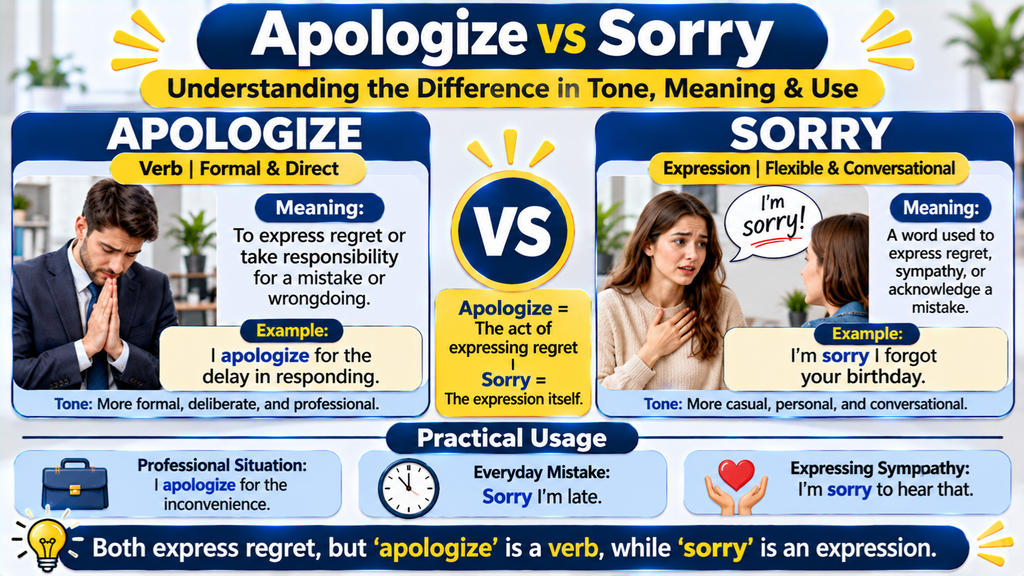
Sorry is a feeling or a quick reaction: I’m sorry. It works in speech, texts and casual messages. It can also mean sympathy, as in “I’m sorry to hear that.”
Apologize is the act of saying so, and it sounds a little more formal and deliberate: I want to apologize for what I said. It is the better choice in emails, official letters and serious situations.
Compare these:
- Casual: Sorry I’m late!
- Neutral: I’m sorry I was late.
- Formal: I apologize for the delay.
Same message, three different temperatures.
Example Sentences: American and British Spelling Side by Side
In apologize vs apologise, the spelling changes but the meaning does not.
- Work. I apologize for the delay in replying. / I apologise for the delay in replying.
- School. The student apologized to the teacher. / The student apologised to the teacher.
- Family. He apologized for forgetting her birthday. / He apologised for forgetting her birthday.
- Business. The company apologized to its customers. / The company apologised to its customers.
- Friends. I’m apologizing in advance for my bad singing. / I’m apologising in advance for my bad singing.
- News. The minister apologized for the error. / The minister apologised for the error.
- Email. We apologize for any inconvenience. / We apologise for any inconvenience.
- Politics. The council refused to apologize. / The council refused to apologise.
- Apology as a noun. She accepted his apology. (Same in both varieties.)
- Polite phrase. My apologies for the mix-up. (Same in both varieties.)
A Workplace Email in Both Varieties
Here is how the same short email looks in American and British English. Notice that “apologize” is not the only word that changes.
American English: We apologize for canceling today’s meeting. We understand the change may have disrupted your schedule and we appreciate your flexibility.
British English: We apologise for cancelling today’s meeting. We understand the change may have disrupted your schedule and we appreciate your flexibility.
The spelling of “canceling/cancelling” changes too, and so do words like color/colour and behavior/behaviour if they appear. That is why consistency matters more than any single word. Once you choose a variety, apply it to the whole message, not just to “apologize.”
Common Mistakes
Most slips around apologize vs apologise are about consistency, not correctness.
Mixing the two spellings in one document. If you write “apologize” in paragraph one, do not switch to “apologised” later.
Mixing -ize and -ise words. Writing “I apologize for the delay and will organise a fix” mixes American and British spelling. Choose one: apologize and organize, or apologise and organise.
Treating one spelling as wrong. Flagging “apologize” as an American error in a British document is often wrong, because Oxford-style British writing uses it. Changing “apologise” to “apologize” in an American document is a matter of house style, not of fixing an error, because both are real spellings.
Writing “apologies” when you mean the verb. “I apologies” is wrong. The verb is “I apologize” (or “I apologise”). “Apologies” is a noun.
Misspelling the -ing and -ed forms. The forms to remember are apologizing/apologising and apologized/apologised. “Apologizeing” and “apologiseing” are wrong.
Using “apologist” for someone who says sorry. An apologist defends something. A person who says sorry is someone who apologizes.
Set Your Spellcheck to the Right Variety
Spellcheck will not settle apologize vs apologise for you. It will not tell you that you chose the “wrong” spelling. It will only flag it if your language setting does not match the word. That is why the setting matters.
In Microsoft Word, you can set the proofing language from the Review tab (the Language option), choosing something like English (United States) or English (United Kingdom). In Google Docs, use the File menu and choose Language, then pick the English variety you want. Exact menu names can differ between versions, so look for “Language” or “Proofing language.”
With English (United States) selected, “apologise” will usually get a red underline. With English (United Kingdom) selected, the spellcheck may accept both or flag the one that does not match its house style. Setting this once at the start of a document saves a lot of hunting later.
A Quick Style Checklist
To get apologize vs apologise right every time, run through these six points before you publish or send anything:
- Decide which English variety you are using (American, British or Oxford style).
- Use the matching spelling for every form: apologize/apologised, and so on.
- Check the other -ize/-ise words in the same text.
- Use to for the person and for for the reason.
- Use the noun “apology/apologies” for the thing, and the verb for the action.
- Follow your school, board, publisher or employer’s style guide if there is one.
Quick Practice
Choose the spelling that fits the instruction. Answers follow.
- (American English) “We ______ for the inconvenience.” apologize or apologise?
- (British English, not Oxford style) “The manager ______ to the guests.” apologised or apologized?
- Which of these is always spelled with -ise: organize or surprise?
- Fix the mistake: “I apologies for the delay.”
- True or false: “apologist” means someone who says sorry.
Answers: 1. apologize. 2. apologised. 3. surprise (it is never “surprize”). 4. “I apologize for the delay,” or “My apologies for the delay.” 5. False. An apologist defends an idea or belief.
FAQs About Apologize vs Apologise
These are the questions people ask most about apologize vs apologise.
Is it apologize or apologise?
Both are correct. Apologize is the American spelling and the main choice in Canada. Apologise is common in British, Australian and Irish English. Choose the one that matches your readers.
Is apologise British or American spelling?
Apologise is the British spelling. American English uses apologize. In Britain, though, apologize is also accepted, especially in Oxford-style writing.
Are apologize and apologise the same word?
Yes. They have the same meaning, the same pronunciation and the same Greek root. Only the spelling differs.
Which spelling is more common?
It depends on the country. According to Sapling’s usage data, apologize is far ahead in the US, Canada and India, while apologise leads in the UK, Australia, Ireland and New Zealand.
Do British people use apologize?
Yes. Many British publishers and writers use “apologize,” and Oxford-style spelling keeps the “z.” It is not treated as an error in British English.
Is it apologize to or apologize for?
Both, for different parts. You apologize to a person and for a thing: “I apologized to her for the delay.”
What is the difference between apology and apologies?
Apology is the singular noun. Apologies is the plural, and it is also a polite phrase: “My apologies for the mistake.”
What is the difference between apologize and sorry?
Sorry expresses a feeling and is casual. Apologize is the formal act of saying you regret something, and it suits emails and letters better.
How do you spell apologizing?
Apologizing in American English and apologising in British English. Both are verb forms with “ing” and no extra letters.
Which spelling should I use in Pakistan or India?
If your school, board or employer follows British conventions, use apologise. If you write for a global or American audience, use apologize. Always follow the style guide you were given.
What is the past tense of apologize?
The past tense is apologized in American English and apologised in British English. Both are also the past participle: “She apologized” and “She has apologized.”
What is the -ing form of apologize?
Apologizing in American English and apologising in British English. Example: “He is apologizing for the mistake.”
What is the noun form of apologize?
The noun is apology, and its plural is apologies. “She offered an apology” and “She offered her apologies” are both correct, and neither changes in British English.
Can I use both apologize and apologise in the same article?
Only if you are comparing the two spellings, as this guide does. In normal writing, choose one and use it from start to finish.
Is “I apologies” correct?
No. “Apologies” is a plural noun, so “I apologies” is a grammar mistake. Say “I apologize,” “I apologise,” or “My apologies.”
Final Thoughts
Apologize vs apologise is a spelling question, not a grammar one. Use apologize for American and Canadian readers, apologise for most British, Australian and Irish readers, and whatever your style guide says if you have one. If nobody cares, go with apologize, since it is the older form and the safest everywhere. Just keep your -ize/-ise words consistent from the first line to the last.


One Comment